
Guest article from bimboss.com
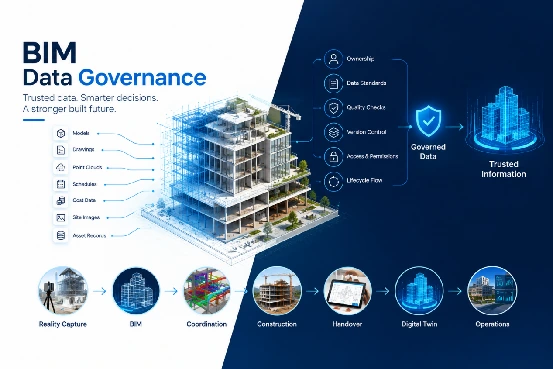
The future of BIM isn't about creating more data. It's about making project data trustworthy, connected, and ready for intelligent decision-making.
The construction industry is generating more digital information than ever. BIM models, point clouds, drawings, schedules, cost data, site images, and asset records are becoming part of everyday project workflows.
But more data does not automatically mean better construction.
A model can be geometrically accurate while containing outdated parameters. Different teams can use different asset IDs. A revised drawing may not match the latest model. Critical information can remain buried in spreadsheets, emails, or disconnected platforms.
The industry doesn't have a data shortage. It has a data trust problem.
That is where BIM data governance becomes important.
From Managing Models to Governing Information
Traditional BIM workflows focus heavily on creating, coordinating, and delivering models.
The next stage is about controlling the information behind those models.
BIM data governance establishes clear rules for:
- Who owns information
- How data is structured
- How quality is checked
- Which version is authoritative
- Who can change or approve information
- How information moves between project stage
The goal isn't to create more rules.
It is to make sure that the right information reaches the right person at the right time—and can be trusted when it gets there.
The Problem of Data Drift
One emerging challenge is data drift. A BIM model represents a project at a particular point in time, while construction continuously changes.
Designs are revised. Equipment is substituted. Site conditions change. Installation differs from the original design. If these changes are not captured consistently, the digital model slowly moves away from physical reality. This creates a dangerous gap between:
What the BIM model says and What actually exists on site.
Governance can help close that gap through controlled updates, validation, traceability, and clear ownership.
Why AI Makes This More Important
AI is rapidly entering construction workflows, from document analysis and quantity extraction to progress monitoring and predictive insights. But every AI capability depends on one critical foundation: reliable data.
If BIM information contains inconsistent classifications, missing parameters, or outdated asset records, AI can process it faster—but it cannot guarantee that the information is correct. Better data quality means better AI outputs.
This is why the future may not simply be BIM + AI, but Governed BIM + AI. Strong data governance creates a reliable foundation for automation, Analytics, AI agents, and digital twins—helping construction teams turn data into more accurate decisions.
From BIM Model to Digital Thread
The future of BIM is moving toward connected information across the entire asset lifecycle:
Reality Capture → BIM → Coordination → Construction → Handover → Digital Twin → Operations
Instead of information being recreated at every stage, a trusted digital thread can allow important data to follow the asset throughout its lifecycle.
That makes information more traceable, reusable, and valuable.
The New Definition of BIM Quality
BIM quality can no longer be measured only by asking:
“Is the model accurate?”
The better questions are:
Is the information complete?
Is it current?
Can its source be verified?
Can different systems understand it?
Can it still be trusted after handover?
This represents a shift from Model QA to Information QA.
And that shift could become one of the defining changes in digital construction.
The Future Is Trusted Data
AEC companies have already invested heavily in BIM software, cloud platforms, reality capture, AI, and digital twins.
The next competitive advantage may come from something less visible: trusted information.
The companies that can structure, validate, connect, and govern their project data will be better positioned to turn digital tools into real business intelligence.
Because the future of BIM isn't about having more information.
It's about having information you can trust.